

The Malflora Collection highlights the lives of Latine lesbians
“For the love of the GAYme”
By Iris Martinez
Publishing by Mel
Members of the Malflora Collective unabashedly share the real lives and experiences of Latina/e lesbians, past and present. With their second issue out, a podcast and a lively Instagram, the collective honors the ancestral memory work of Chicana and Latina feminist and lesbian scholars of the past while documenting the present. Five of the nine current members were interviewed for Dirty Dyke Magazine to talk about the collective and their experiences around it.
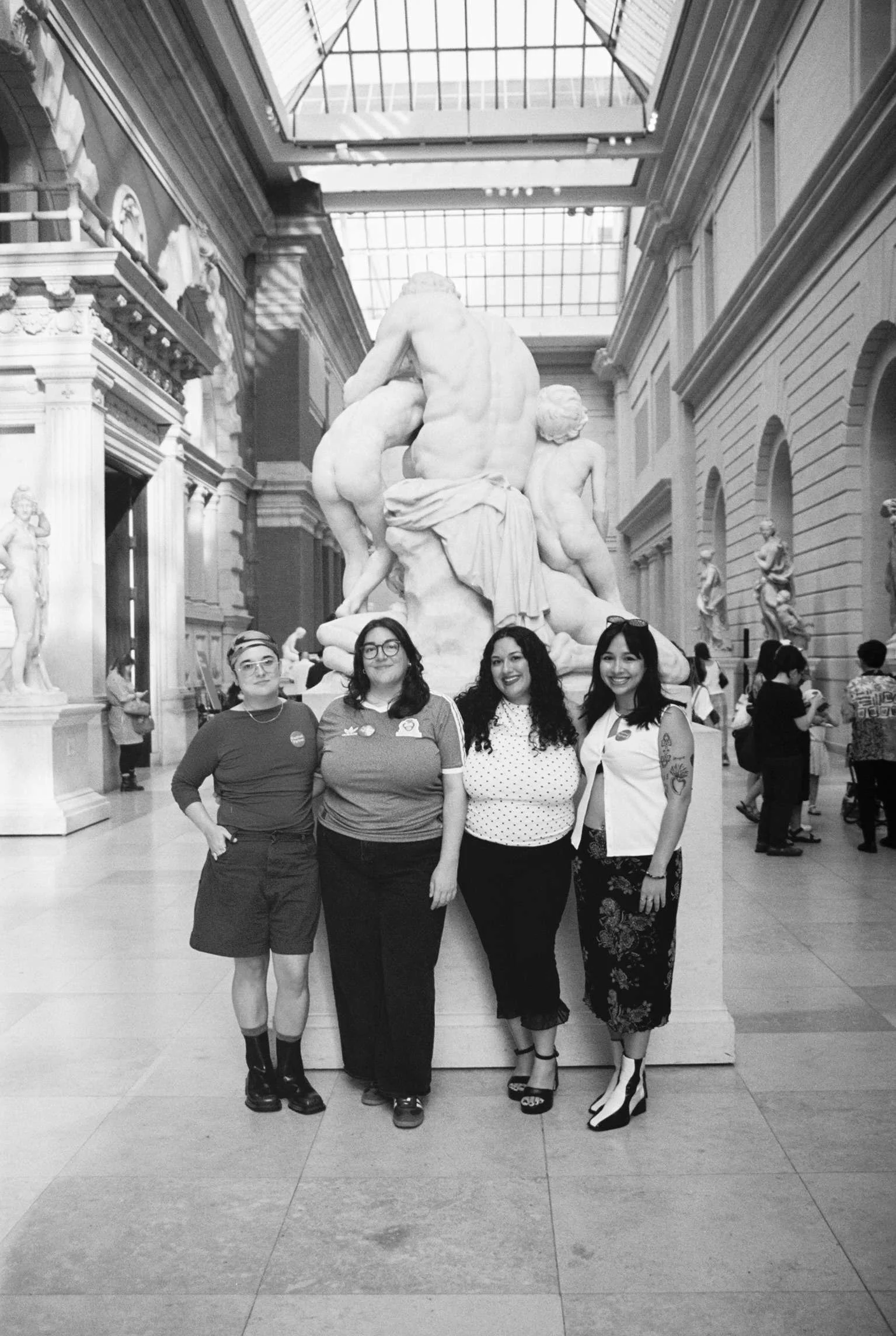
Lu, Melissa, Alexandra, and Anahí at the Met for their 2026 Pride Date Night event, where Malflora members facilitated a creative workshop on collaging queer self-portraits.
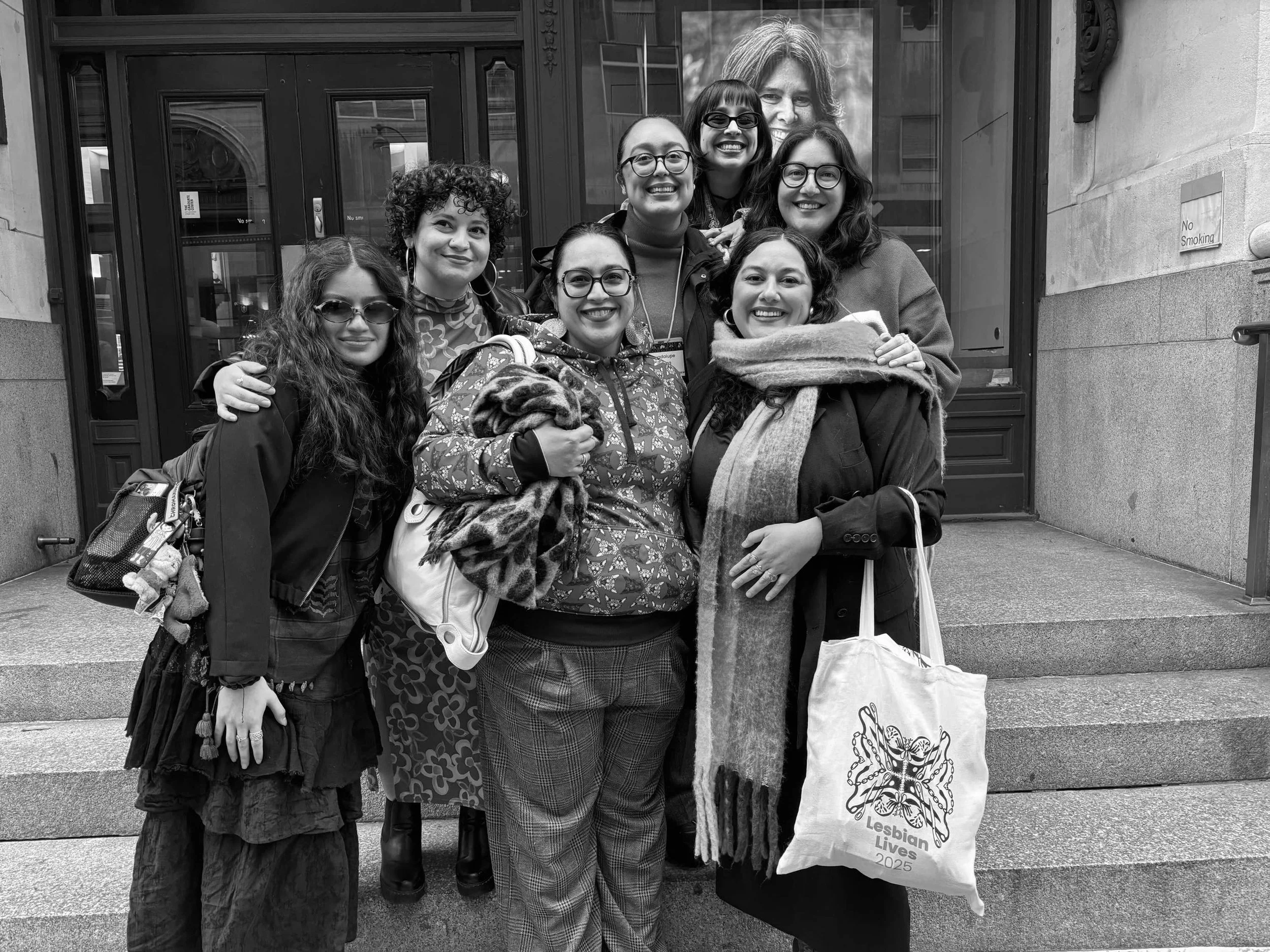
Mia, Meagan, Mariana, Guadalupe, Anahí, Melissa, and Alexandra at the 2025 Lesbian Lives Conference in NYC, where we presented on a roundtable entitled "Latina/e Lesbian Archival Praxis and Memory Work: A Plática/Roda de Conversa with Malflora Collective.”
THE TEAM BEHIND MALFLORA
MEAGAN SOLOMON (she/her/ella):
I'm a Tejana, Jewish, scholar, educator, and I consider myself a memory worker in this work, and one of the co-founders of Malflora Collective, alongside all of these amazing people. I am also a feminist studies professor in the Austin area and teach courses in Latina lesbian literature and women of color feminisms. For those who might be less familiar, my identification as a Tejana, signals that I have ethnic origins in the Texas region of the United States, which has a long history with Mexico, and my family has been here for many generations, so I've adopted a very, kind of, regionally specific identity, as someone of Mexican descent, but who was born and raised in Tejas, or Texas. Also, I'm a Pisces sun.
ANAHÍ PONCE (she/they):
I'm from El Paso, Texas, and — more so than Chicana these days, which I do loosely identify — I really am keen on using like a Fronteriza identity to connote that I grew up along the US-Mexico border. And I think that experience has shaped so much of everything else. So it is something that I lead with in how I identify and also just in my work in uncovering queer Fronteriza history along the U.S.-Mexico border. So that's a big part of me and about me. I'm also a Scorpio, this Venus retrograde is kicking my ass. And I just recently got my PhD in Latina Studies alongside Alexandra over here, and I'm living my dreams in this post-grad moment where the world is decaying. But here I am, amongst all these lesbians, so I don't have too much to complain about.
ALEXANDRA SALAZAR (she/her/ella):
I am a Cancer with a Sag rising in Aries Moon, and I am originally from the Rio Grande Valley, also known as the Rio Grande Delta, the 956, and Somisek, which means Land of the Sun. Just like Anahí, yes, also very much shaped growing up along the border, border region, but in a different part of Texas. I'm a Chicana lesbian, and I, like, Anahí just graduated with my PhD from the Mexican-American Latinx Studies Department at UT Austin, which doesn't exist anymore. But I think it's just really, really important to say, given what's happening, and the continuation of anti-DEI efforts, anti-Latina efforts, anti-Mexican, anti-Chicanx, anti-queer, anti-lesbian, all of those things. And then, in addition to being a part of Malflora, I also have a podcast called Jotxs y Recuerdos, where I interview queer people from the region that I'm from. So, just been doing queer archiving for like… Through the podcast for a decade, but I'd argue that every single one of us here have always been queer community archivists since we were younger, just collecting, like, relics of ourselves and of our queer ancestors, and I think that's a big reason why we're together. It's because we shared that, like- that animal, that feeling, that effect of, like, queer belonging through the archive and beyond.
LU FARRELL (they/them/elle): I am a Tejane, butch trans artist and sustainable designer. I'm in a master's program right now getting my master's in sustainable design. So that's a newer addition to the list, and I'm from San Antonio, Texas, so definitely would echo kind of what Megan was saying about kind of the important cultural mix that takes place, being generationally from Texas and having Mexican lineage and existing in that funny space that we do. I mostly do kind of creative design visuals with the collective, but also I think I can pretty confidently say that we all kind of dabble in different domains, but that's where I tend to exist the most. And I'm a Leo sun.
MELISSA ASLO DE LA TORRE (she/they/ella/elle):
I'm based in New York City, I am a librarian here at New York University. I'm the librarian for Latin American, Caribbean, Spanish, and Portuguese Studies. I met Alexandra and Anahí when I was a graduate student at UT Austin.
Like Alexandra said, I am a queer community archivist. I think I was doing that work long before I went to an information studies master's program. I was raised by my immigrant Mexican immigrant mother in Missouri. So I guess I'm a Midwestern Mexican. I grew up far from the border, but the border was still very present in my imaginary and my lived reality as the daughter of an undocumented mother who could no longer cross the border back home, and I could as a citizen. So that very much shaped my position, my self-formation — and I'm also Arab, but I was raised Mexican. I like to make zines.
WHY “MALFLORA”?
HOW DO YOU DESCRIBE YOUR COLLECTIVE?
MEAGAN: Well, the project, in some ways was… We might say my initial brainchild, that I raised with everyone. I got the name Malflora from some archival images from 1976. There was a Christopher Street West Pride Parade in Southern California, and a Chicano artist named Joey Terrill made some t-shirts with the reclaimed slurs, malflora for lesbians and maricón for gay men.
The shirts were worn and documented in this parade, and I knew this term but this made me further interrogate it. I liked the concept of reclaiming this term that more or less translates to bad flower, because I think it embodies some of the kind of rebel spirit of the collective in the sense that we are invested in resisting cultural and social conditioning around lesbians being traitors to our cultures and actually seeing ourselves as stewards of our cultures instead.
MELISSA: In my research, I found that in 1975, the year prior to the malflora t-shirt debut, Joey Terrill had made the shirts for maricón, for him and his friends to go to the Christopher Street Pride Parade in Los Angeles, and then the following year, his cousin, Pat, and her partner, Martha, were like, we want shirts too. So, it came from this direct ask from a lesbian family member that was like, we want those shirts, too, but for us. I just loved the little detail of how the Malflora t-shirt specifically came from a specific request from a lesbian loved one of his.
MEAGAN: There is an interview that he did… There was an exchange with a relative or friend where they couldn't remember if it was manflora or malflora, and they were like, we like malflora better. I love that it came out of this, like, demand, which… I will use that as a segue to also name that one of the reasons why we specifically focus on Latina/Latine lesbians, is because, oftentimes, our distinct identities, as diverse as they are, are not always given focus in larger historiographies of Latine queer and trans life.
As much as we see lesbian existence as part of that larger community or set of communities, we also want to underscore the specific, gendered experiences, racialized experiences of Latina/Latine lesbians and, really place ourself in a lineage of other Chicane, Latine lesbians who shared a similar commitment to uplifting our unique stories at the intersections of our racial identities, class, gender, etc., etc.
MELISSA: We're a community organization focused on preserving the everyday lives, histories, and legacies of Latina/Latine lesbians, and I think the important part of that is the community part. I mean, all of it is important, but I think this is very much a community-based effort. Some of us have institutional affiliations, but a lot of this labor is happening on our own time, unpaid, you know, as Lu said recently at our retreat, for the love of the GAYme, like, you know, we're doing it for ourselves.
ALEXANDRA: The way Malflora exists now is everybody's brainchild, and it is a labor of love that we all do together, and we've all already been dreaming so queerly, and so Malflora has been a really lovely space for us to dream queerly together. We do the archiving through our podcast and our magazine, and our soon-to-be digital archive. I would argue that our Instagram is a digital archive, but our future goal is to include it on our website.
LU: I really try to emphasize the collective notion of it, because we really make an effort to avoid hierarchies. We even have talked about removing labels or titles from the way we work together. I think it's important to consider that, as we talk about these different kinds of archives that we work on, it is very much a group collaboration, and we very intentionally work to make sure that everyone is being heard and considered.
MEAGAN: We initially came together through existing networks, and so, a lot of us have a relationship to Texas, which I want to highlight. I think a lot of people, especially those outside of Texas, have preconceived notions about Texas, and who lives here and who works here. I think our work shows that Texas is a space where radical work is happening, has always happened, will continue to happen. But, I already was connected to Alexandra, who was connected to Melissa and Anahí through school, and I think that network brought more people in.
I also knew Lu from Austin as an artist, and so other people in the collective then reached out to other people that they knew, and so it was kind of this expansive network coming together. Our members are based all over the U.S, so we have folks in Texas, on the East Coast, on the West Coast, in the Midwest, with different connections to Latin America more broadly. A lot of us are Tejane, Chicane, but we also have a member who's from Brazil, born and raised, and spent most of her life in Brazil — Mariana.
We have a member, Milo, who's born and raised in the Dominican Republic, and has spent most of their life in the Caribbean, and so it's important to us to reflect as much, as we can at this juncture, the diversity of experiences that exist within that umbrella of Latinidad, which we really push back against as being a single, uniform experience, just like we do with lesbianism, understanding it is also very multiplicitous and diverse.
WHAT IS IT LIKE WORKING TOGETHER, AND WHAT HAVE YOU LEARNED THROUGH THIS WORK?
MELISSA: We're 2 years old, so we're still a little baby, but we kind of figured out it made sense to have a monthly meeting, and we kind of try to stick to having at least one monthly meeting, while we also have concurrently running projects. Sometimes, some of us are planning to go to a conference, so then we kind of have different meetings throughout. I think we all have different strengths, and for example, this summer, we had the opportunity to participate in an event at the Met during their Pride date nights.
They invited us as one of the community organizations, and part of it was running an artistic workshop, and I immediately was like, we have to get Lu to New York to dream up this artistic workshop. I was just so impressed by working with Lu, who is an artist that runs workshops a lot, and that was something that I don't do a whole lot of, so it was really amazing to participate in that with them, and to just see their creativity shine, and to see the event, you know, come together that way.
ANAHÍ: In the beginning, I feel like there was sort of this want to run before we really walked. A part of that is figuring out not just logistics with timing and working across three different areas, but for working in a big group project and accounting for our different versions of what collective work can mean. And also. I think with that early on, again with the issue of leadership roles and titles, we all kind of agreed that we wanted to work horizontally and non-hierarchically, but when it came time to practice that, we were coming up with, like, okay, so what does this mean for this person if they're taking on this role?
And we were still coming up with the difficulties and questions of, okay, how do we enact horizontal leadership in real time, not just as this theoretical concept, but as something that can work for us with the millions of deadlines that we assign for ourselves. That wasn't without some friction, just coming together as a new group, and for some of us who were connected before, it was, like, we had that, but for coming together, all nine of us, in this way, in the beginning, was something that did take time to develop, and I think, you know, at this juncture, post the retreat we just had this last weekend, I feel like we've really come out at the other end of that, and a lot of that is just, like. by nature of doing things like trial and error, and figuring out what works, and leaving what doesn't, and whatnot. But, as part of our retreat, we talked a lot about how flexibility and leading with grace and coming from a harm-reductive lens from each other…
Basically, just giving each other the space to mess up, to get busy, and to procrastinate, and to just be human beings outside of this work that we do has been something that I think that's been really integral to the flow that we've now been able to achieve at this two-year mark. We've really crafted this version of radical care in a way that makes sense to us, in a way that works for us, and it's been really beautiful to see. It's something that I think with queer collective work you expect initially, but I just don't think that's the reality of who we are as humans. We need time to sort of figure things out and experiment with the work and with each other.
I think we're at a really good spot now where we've been able to do that, and I have a lot of hope that we'll be able to continue doing that in a way that is holistic and not so, like, we're doing the work not because it we need to produce for the sake of producing, but it really is just doing what works for us, and also, doing work and talking to folks that we've been talking to, individually and collectively, in a way that is reciprocal, in a way that always asks the questions of, like, okay, what are we doing, if we have funds for this, how are we pouring that back out into community outside of ourselves? And I think that is something that's really grounded us up until this point.
LU: I think I have learned so much about myself just working in this collective and how I connect with my lesbian identity and how I connect with my Chicane identity. But, even bigger than that, I think I have learned so much just broadly about leadership, and I think in so many ways, the work we've done together and the successes and progress we've made together is a pretty amazing testament to horizontal organizing, and, not something I've really experienced in… surely not in a workplace, and very rarely on group projects. I think about us often when I have to exist in other professional settings, and think about how much more radical care could be taking place everywhere in a regular way, and also how successful it can be.
Given how much I think many people want to center, quote-unquote, more traditional power structures, because they've come to this conclusion that that's the only way is to have particular people holding most of the power and dictating what comes next. In my personal life, in my life in grad school, I talk about us all the time, because I think that it wasn't just out of the box, we know how to do this. We've definitely used trial and error and figured out things that work best for us. But within 2 years, we've been able to produce two beautiful magazines, a really amazing podcast. We're getting this archive started and putting it together in a more tangible way. And I will take that into every professional environment I exist in moving forward.
MEAGAN: I kind of laid the foundation coming in, having presented the idea, and then had to run it back, because we were realizing, like, this wasn't as collaborative and collective as it should be, and perhaps I was operating from this place of, as Lu was mentioning, more traditional frameworks of leadership, or I was approaching this in a way that I was just used to, but I feel like it really meant a lot to me to be called in, as uncomfortable as those conversations can be. It helped so much with our trust with one another because we made it out of the other side.
We're still learning and we're still growing, but if you look at the archive, you'll notice that there are a lot of groups or publications that didn't last more than a few years because they could not contend with internal tensions. In an effort to sustain our work as long as possible, we had to really contend with our tensions, and see those not as detrimental to the work, but actually necessary for our growth.
It made us a lot closer as people.
Anahí mentioned this before, and I hadn't really thought of it that way exactly, but because some of us knew each other already, you were already coming into the space with a level of trust, but then others of us were still building that with each other, and that can change how we dialogue and interact, but regardless, I think something we learned is you do have to build trust in this work, which is why we're being very careful and thoughtful about how we approach bringing in new members, not because we don't want to, because we absolutely do, but we want to respect the time that it took to build the trust we have, and also make sure that any new members have shared values and align with our collective visions and want to contribute in that way.
I also want to say that it made it so that at our retreat this past weekend, where some of us got to be together in person, it turned into just a space where we could cry and laugh and stay up all night talking, and I feel like that's the kind of relationality that we embody and want to have moving forward, and I think that also shows that we are much more than just academics, which not all of us are, anyway. We're just lesbians who want to yap and cry and laugh together, honestly.
LU: Although many members of the group are connected in their work in academia, that is very much not the way we connect amongst ourselves, and very intentionally have tried to push back on and move away from that academic ivory tower. And so, a lot of the work we do definitely has that kind of informational underpinning of just certain people being so well-versed in different areas, but also very much centering the community and the creative, rather than trying to contribute to the academia as being the main focus.
WHAT HAS BEEN YOUR FAVORITE EXPERIENCE OR PART OF WORKING AS A COLLECTIVE?
ALEXANDRA: I think my favorite part, really, is just being in a collective with people who are like-minded. I know that we are all pro-Palestine, ACAB, against U.S. imperialism in all forms, so it's really nice that I don't have to explain things or perform anything. We are literally on the same page and understand that the work that we're doing is urgent, and there's meaning behind it that we share.
We are lesbians who are anti-TERFs, like, we are not TERFy in any way, shape, or form, and I think that's also a big part of our work, where when you look back at lesbianism, there has also part of the history been TERFs, right? And sometimes, and even till this day, people still associate the term lesbian with TERFiness, and our work is also inherently combating those notions. I mean, all of it's my favorite part, but it's the fact that, like, I'm not dreaming alone anymore.
ANAHÍ: We've been able to think and dream about lesbianism in line with how it has been, by folks who have come before us, by queer ancestors who have also lived along these lines, but we're able to continue that legacy and continue to be, like, really adamant about lesbianism as a radical politic, as something that's anti-TERF, anti-colonial, that isn't invested in hierarchies and those sorts of things, and doing that in collective is always really beautiful, and it allows us to connect with other people in our immediate communities who are doing that work. Last year, we had been invited by someone in the Austin community who was doing a Latina lesbian event at this bar in east Austin.
We went, and it wasn't a super big turnout or anything, but a couple of our friends came, and we were able to connect with folks in the community who we hadn't before, and we took Polaroid pictures of people, and just sat, and after a while of doing the little booth setup and being like, this is who we are, we're selling a magazine, here's a sticker, whatever. After like an hour of that, it very casually and quickly and organically just became like a bunch of dykes sitting around yapping and, you know, being chismosas, and that was a really beautiful moment that I think about all the time. It makes me miss Texas a lot, honestly and it was Malflora members and non-Malflora members alike, and it was one of those really beautiful opportunities.
It's not just about holding the theory and having the same shared ideological theoretical belief, but it's equally about the practice part of it, even when we are so geographically disconnected in some ways. It makes the moments where we are able to meet up, even if only digitally, that much more special.
I think, you know, I'll speak for me and Alexandra as two people who are coming right out of the academy. I feel like one of the things that bonded us really quickly early on in our friendship was, in many ways are like we don't take ourselves too seriously, like in the academy and like the respectability politics that comes with higher ed just wasn't inherently who we were and we're not the type of people to sort of make the academy our whole lives and in many ways I think that for myself at least like I've sought out other people in those spaces who kind of move in similar ways. And in that, I found this amazing group of people.
For me personally, I think that has been also really important. Like, yes, carrying this long line of, like, lesbian memory work along these radical lines, but also doing it with people who are able to connect on a human level outside of this performance of intellectualism or whatever that can sometimes take shape in particularly academic spaces, but generally. I think all of us are really connected in our ability to not take ourselves too seriously and to have fun and be a little silly goofy with it. A lot silly goofy with it.
MEAGAN: Many of us have relationships to institutions, but don't see those institutions as our homes by any means. In fact, we very much feel the hostility of these institutions, and in many ways, Malflora provides a sanctuary from elements of our lives outside of this work that really demand a kind of hyper-isolation. Scholarly work in a traditional context kind of assumes that kind of isolation as part of the work, and so having this space where we can be in community and really focus on relationality helps resist that and gives us a really sacred space to be together against that kind of hyper-isolation that's expected or demanded of us, for those of us who are in academia.
My favorite part of being a professor is teaching, and no surprise that that is a communal endeavor — you are with people, you are having conversations — but then there are also elements of the work that are so performative and competition-driven and demoralizing in so many ways, and so this gives a lot of life to me in the midst of all of that. And I also think it's an intellectual space as much as it is a silly, goofy space, and I love that we contain multitudes in that way, because I learn from everyone here so much, and I really appreciate having a space where we can talk about things that matter to us and learn from each other.
Another favorite part for me, staying along the lines of relationality, is the relationships that we also build outside of each other. With the podcast, which I am a co-host of alongside Alexandra and Mariana, we get to talk with Latine/Latina lesbians from all over the world and from different generations, and I think for so many of us, we don't always have direct connection to elders. That's been a really special part of the podcast work, is getting to have intergenerational connection, which we want to sustain in other ways too, but just learning from people and having their trust to share their story with us and to just be in dialogue is really special.
LU: Being a queer person in Texas, being a non-white person in a very white space, professionally or personally… there are various different kinds of isolation that, depending on who we are, we might be experiencing, and I think that this is an active effort to combat that on multiple levels, both for myself and for other members, but also just connecting with people outside of the collective over our work. Definitely, there have been times when people have spoken to me about how refreshing it is, as a lesbian, to find media that's being made right now, this very moment, that is specifically by and for dykes.
That has existed historically, and a lot of those magazines don't exist anymore, and so I love continuing that legacy. When we were in New York hosting this event at the Met, I think that was something that I loved the most. I was thinking a lot about what it meant to be in this very institutional space doing the kind of work that we do.
I'm so glad that we did it, because there were so many people that came up to us and were just so excited to see our work and connect with us in person, and sit at the table and be part of it. In particular, I remember this older woman who came and sat next to me, and we were collaging and talking, and I think she stayed maybe the whole time.
She never said it explicitly, but I could just tell that she really appreciated being able to just exist in that space and see young people doing that work and share stories, share experiences, without explanation, without apology. The only time I'm ever around exclusively lesbians is with this group. I mean, even when I'm in quote-unquote lesbian spaces in Texas, there's always overlap, which I wholeheartedly encourage, and I'm happy to have that expansive community, and also… It's so wonderful to be able to exist in this space just as we are.
MELISSA: It's been so important for me and my own understanding of myself to be in close community with lesbians, and I think it's helped me understand myself better, and accept myself better. It's so affirming to be in this shared space with people, who, like Alexandra said, not only share the identity of lesbians or dykes, but also have shared political values.
I was telling my best friend about our retreat after I got back, and she really reflected back to me just how special it is to be a part of this community. She was like, there's a difference between a friend group and a collective, but it's so beautiful when the collective is also a friend group. I think that's something that just kind of grew organically and over time. To be able to be with my friends, doing work that we all care about, that we're all deeply committed to, is just, like… I don't even have words.
WHAT HAVE YOU SEEN THROUGH WORKING WITH MATERIALS ABOUT EVERYDAY LIVES THAT YOU HAVEN’T SEEN IN OTHER ARCHIVAL WORK?
MELISSA: I was thinking about this recently in the context of our zine. I feel like that's a space where we get that, both visually, artistically, but also there's a lot of essays, poetry that gets submitted. Having worked on the editorial team for the last issue, getting a first-hand look at the submissions and working with the authors and seeing the variety of experiences that they're documenting through their creative work was really amazing.
I think what I love about the zine is there's no sort of pretense at being sort of exclusive, you know? It's very much a space where if someone is submitting work along the themes that we're hoping to be in conversation around, there's space for that work. And it doesn't have to be perfect, you don't have to have published before, you know.
So I think, even Meagan's partner — sorry to steal this from you Meagan — but Meagan's partner took a photograph that was so stunning, so, so, so stunning. It's called Lesbian Hands, it's the first piece in our magazine, so if anyone wants to buy our magazine, shout out to Meagan's boo, Daisy. Daisy took this photograph, it's stunning, but Daisy doesn't consider herself a photographer or an artist, but through how excited we were to have this piece in our work, Meagan shared just kind of, you know, it took a while to feel like, oh, I can call myself this. But I think that's part of it is like there is space for all of us here for this shared experience.
It's not based on who you are, who you know, what you've done before. It's about what creative work or what self-reflective work or whatever you're bringing to the table right now. So I think that's part of kind of dismantling the ways in which some stories get privileged over others, or some histories, or some experiences get privileged over others, even within a community.
MEAGAN: We approach the magazine, like the podcast, as an archival repository, if you will, in the sense that it is actively archiving the works of Latina lesbians and queers and trans folks now through their creative practices. This isn't always an art form that's considered inherently archival, but the way that we approach it is in the sense that we are considering our work not just archiving the past, but archiving the present. We hope, of course, that future generations can also look at this work, but it's also a recognition that our lives and our existence matters now, and the works that we do matter now, and we want to create a creative outlet to uplift that, and to do so, as Melissa said, in a variety of ways and modalities.
Our magazines invite different kinds of creative works. We have personal essays, poetry, photography, diary entries, we have art and hybrid works, someone submitted a part of a screenplay to our last issue. We also want to really recognize the diverse forms of art that folks in our communities produce and to see those as legitimate forms of expression and even knowledge themselves that we take seriously, regardless of whether the ivory tower takes it seriously. Just on that note, really quickly, because some of us do have relationships to institutions.
We did publish an academic article because we do see the work that we're doing as contributing to knowledge, and we wanted to give language to that, but it's not necessarily something that we invented. We're actually just giving language to cultural practices that have existed in our families and communities forever, and showing how we are applying that now. The way that we engage the creative knowledge-making and expression of our magazine, or the way that we engage dialogic or conversational archiving in our podcast — we wrote about that, and we might still continue to write about that or present about that regardless of whether academia values it. We're going to assert ourselves in all the spaces.
WHAT MEDIA DO YOU RECOMMEND?
MELISSA: At the retreat, we had a mentor, elder, come and speak with us, Anel Flores, who is a writer, but one thing that she brought to share with us was this really beautiful, like, hand-bound book by Tatiana de la Tierra, and it was called Porcupine Love and Other Tales from my Papaya.
MEAGAN: A recently published anthology by some of our friends and mentors, Anel, Rita, and Jackie. It's called JOTA, and it's mostly creative writing. It was published by a small press, so you may or may not have heard of it, although Sinister Wisdom shouted it out, not too long ago, but that was in the works for, like, a decade. Some of us are close with the co-editors of that collection. Tatiana de la Tierra also was the co-editor of the first Latina lesbian magazines in the US, called Esto No Tiene Nombre en Conmocion, which we talked about on social media if you want to go back and look at the names. Issues of those magazines, which deeply inspire our work, are held in some archives around the US, but primarily in Southern California, but I think New York, too.
LU: It's funny you ask this, because we talk about our favorite lesbian and queer media all the time, that's one of my opener questions that I have made the group answer many times. But one that I always return to and that we all admire, because we all love Roberta Colendres and want her in our lives on many different levels. But there's a TV show that she was in called "Viva" that I think was on Starz. That was incredibly formative for me when I was figuring out my identity, but it's also just a wonderful story about two sisters who moved back to LA after their mother had passed away.
One of them is a lesbian, and throughout the show, she's kind of figuring out that part of her identity, and when they move back, they come to realize that this bar that their mother had always opened was actually a lesbian bar, and they didn't really know that. It was also kind of low-key because it was, you know, in East LA, and it was very community-centered. But I love that show, I talk about it all the time, and it has some great overlap of all of our favorite subjects.
ALEXANDRA: I mean, there's really so many recommendations I can give, but I'll just say Cheryl Dunny's movie “The Watermelon Woman” was very formative for me. I think even as a queer memory worker and archivist, that movie shaped me. And Fabi Reyna, who's a, lesbian from my home region, and is just so hot, and brilliant, and beautiful artist.
WHAT IS THE HISTORY BEHIND PLÁTICAS AND HOW DO YOU COMMIT TO IT IN YOUR WORK?
ALEXANDRA: In our article, we actually write a lot about plática as a methodology, and I really consider it just as a form of knowledge-making practice based in conversation. I think so many of us grew up with that as a form of knowledge-making, because we grew up sitting outside and talking with multi-generations, or sitting at the kitchen table. It's a practice rooted in that practice of having a conversation, but specifically that it's a form of knowledge.
We made it a point to have plática as a form of methodology, but more so, it's an oral history, right? Like, this is an oral history podcast and I think that was important for us. It's a cultural practice, right? And our archive isn't just this surface level, there's no meaning, no feeling, no affect, like, it's a very cultural, ancestral practice for all of us, I'd argue, and so I think that's a big reason why we chose that format for the podcast. And it's also a baby, and we're still working on it and collecting oral histories, so when this piece comes out, I'm just gonna shout out that if anyone is interested in being a part of our podcast, that we are taking, people.
MEAGAN: While this ancestral practice has existed forever in different cultures, in the way that we were employing it in the article and in our work, is very much informed by Chicana feminist thinking, because Chicana feminist scholars and practitioners like Dolores Delgado Bernal helped give language to this practice.
We approached the podcast with that kind of similar ethos, but I also want to shout out our member, Mariana. One of the things we also learned getting to do work with her as someone from Brazil, is that there's a similar practice in Brazil called roda de conversa, which she described as kind of discussion circles, that draw from African, Indigenous, Brazilian ancestral practices that are similar in the way that it's also a kind of dialogic, conversational knowledge-making practice. It actually helped us think about plática and roda de conversa in kinship.
These are practices that have existed across different hemispheres for a long time that we are employing in our work. We have the magazine and the physical media, which we find very important, but we also have the digital that can travel in so many ways, all over the world more accessibly, too, and the podcast does that. Rather than see the podcast as just a repository for interviews, what we see as making it different in the way that we employ plática, roda de conversa, is that it's reciprocal. It's conversational.
We do have featured guests, and it is based on their stories, and we are highlighting them, but we don't shy away from sharing our own personal experiences in the process, or connecting. We see it as a vessel for connecting, and so we hope that that will be visible to people when they listen.
HOW CAN OTHER LATINE LESBIANS INCORPORATE THIS PRACTICE INTO THEIR LIVES?
ANAHÍ: I'm not a part of the core podcast team by any means, but the first podcast episode that we have through Malflora is like a plática with all of us. I was really excited about implementing that, because for me, I was someone who was in many ways raised by my grandparents and we had a lot of communal gatherings.
My grandparents would have a carne asada every Saturday to this day for my entire life. It was a moment for us to come together and to commune weekly and to check in with one another, but it was also an opportunity where we would sort of all – now, I see it as knowledge making, but back then it was just, for lack of a better word, shooting the shit with my cousins and my tios and stuff. Those gatherings were always really exciting because the food was bomb one, but two, it was the way that my family specifically talks is so layered and not like, you speak, I speak, you speak, I speak. It's very much like we speak and while this conversation is going to be happening, there's going to be a tio grunting, making noises over there, and my cousins are going to be over there.
It’s just very interactive, and not so linear, and it's messy. I think part of that first podcast episode that we did for Malfora was in some ways trying to emulate that experience that so many of us have, coming from these family dynamics, where we're accommodating a lot of personalities in one room. I would say, for Latina lesbians who are interested in doing this work, I can guarantee you that 9 times out of 10, you're probably already doing a lot of these practices without even realizing that that's what it is.
I think that certainly has been the case for us, and is a method that we really want to highlight is, like, not being specific to us as researchers or for those of us who are like associated with academia, but is really something that is familial embodied. It's not rooted in a performance or respectability politics necessarily, but it's rather something that comes very natural, like second nature in some ways. I don't know if I necessarily have advice more than I'm like — besties, you're already doing it! Grab a mic, record something, I don't know, get curious with it. For folks who are looking to sort of be more intentional with connecting with their family members and their elder family members, I think just starting small and asking them about their days, and then long-term, like, okay, tell me, Grandma or Grandpa, Tio, Tia, whoever… I'm at this point in my life experiencing these issues, tell me what you would do if you were my position. What kind of things would you do when you were this age? What do you think about this? Was it like this when you were X age? I think those kinds of questions are so important and get you there.
It's very Chisme forward and a lot of the times with elders, they are the biggest chismosos and chismosas. They are itching to tell you their life story, what they were wearing, how they were thinking, what girl that they hated in high school or whatever that they still think about to this day. They are really really eager for that so I think just being open to really active listening is really important to that. A lot of the times we're already doing these things. We just don't necessarily like clock it as, oh, I'm doing an oral history.
MELISSA: 100%. When I was, I think still in my teens, I was like, I need to know everything about my grandma. I've heard all these stories from my mom, I've heard all these stories, but like, I, I felt just like it was urgent for me to interview her and record it. I had never heard of oral history — I was a teenager, I didn't know anything about anything. I took the first Mac I ever owned with me, and I recorded my grandma, and I just asked her a bunch of questions, and it was a little messy, there were questions she refused to answer, but it was very real. We did it at her kitchen table.
It's like, in the context of a podcast that's recorded in different times and spaces, we don't get the kitchen table, we have to bring that with our intention. If you can do it around a kitchen table, if you can do it around food… Food really connects us, it's in our heart, in our bellies, and I think that can really unlock the door sometimes.
I have been in contexts where I'm around elders, and if I bring food, you know, then suddenly they start talking, we start talking, we start sharing. The first time this happened to me, it was in a research context and I was meeting some elders who were archivists and I brought food just as a gift offering, you know, just didn't wanna show up empty handed.
Then as we started talking around a kitchen table, I was like, oh my god, plática, plática's happening! So it's, like, the ways in which, like, Anahí is saying, like, you know, you're already doing it, you just don't know. It's the ways that you're acknowledging that knowledge is being shared outside of, you know, maybe traditionally valued forms of knowledge sharing within the academy, but, like, it's happening in our kitchens, it's happening on our front porches, it's happening in the podcast booth, wherever.
ANAHÍ: It very much is the vibe of when you're having a time with your friends, and you're like, wow, we are so profound, we're so funny, we should start a podcast. Like, it is that energy, and I know it's corny and silly, like with podcasts generally, not our podcast or queer, sort of leftist podcasting generally, but like there is like this influx of like cis men with podcasts.
And so I don't want to encourage that by any means, but like it is that energy that I think for those of us who are coming from communities that are historically marginalized many times over, like across different spaces. Harnessing that energy is really important, and is a way to to preserve community, to preserve knowledge and it is that deep, you know?
LU: We were talking about this during the retreat — if you're keeping stuff from your ex, you're already archiving things. I think a big part of it is, just keep things. Lean into that sentimentality, lean into keeping it for later. Put it in a box and hide it under your bed if you can't look at it right now — definitely have experience with that myself.
There's also just certain things you just shouldn't let go of, and are so important to keep, because down the road, you know, your grandchildren or future people in your life are gonna wanna hear those stories and see the pictures. If you're sitting around the fire with your friends talking shit, take a picture or record a little bit. It really is as simple as that and just wanting to preserve those memories however they look.
I think the other thing I would say is to leave a trace wherever you can. Like, I think that's something I think about with our work, is that we are submitting ourselves to academic publications so we will always be there, and we're making these zines so that there will always be physical media of us existing, and we're doing this podcast to have the record of those pláticas and those conversations, and they're just all different kinds of archive work, and we are leaving our trace wherever we are.
There are definitely presentations I gave at past jobs about queer etiquette and, like, what to do at a drag show so that my coworkers would know to bring cash and things like that, and those are in the old agency I used to work for. Just unabashedly leave a trace wherever you go, and be wholeheartedly yourself, and also selfishly submit to our zine, and we can help you archive all of those things.
ALEXANDRA: We cannot ignore the reality of our world, and that is that we are facing multiple genocides, and people think that what's happening in Sudan and Palestine is so far removed from us, and it's not. And part of what the state does, the United States of America, is an attempted erasure, right?
Sometimes it is an erasure, but we know that with us, it's never erased, right? I just think that it is urgent and critical and important to archive queerness in the face of violence. Just be gay. Just be gay and do crime, and decolonize that mind, fool.